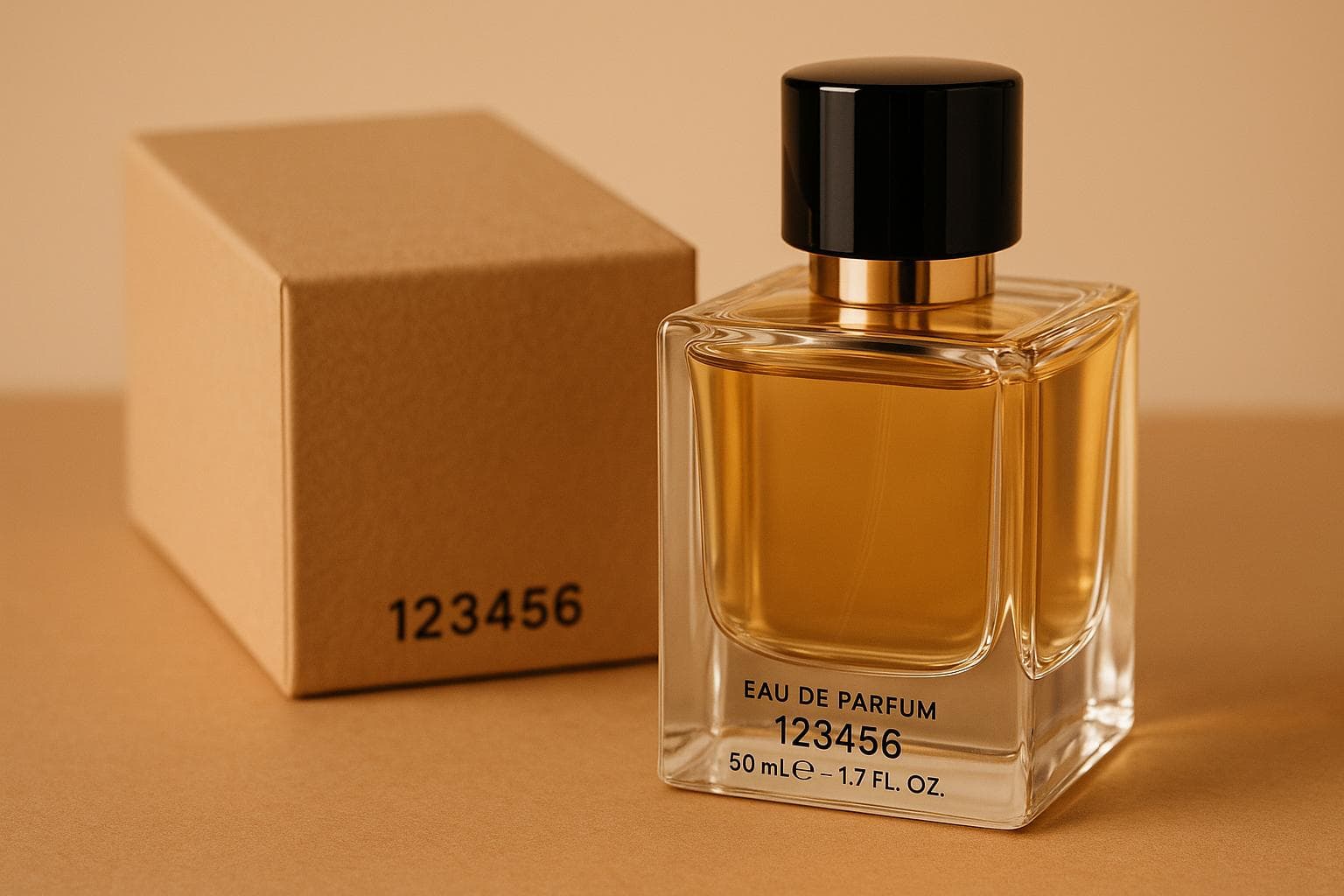

How to Spot Fake Perfumes Using Batch Codes
- The counterfeiting crisis is enormous: The global counterfeit perfume market surpassed €3 billion in 2025 and is growing at 15.8% annually — far faster than the legitimate fragrance industry. Counterfeits now account for 28% of global perfume sales.
- Fake perfumes are genuinely dangerous: Counterfeit fragrances have been found to contain methanol, industrial alcohol, heavy metals including lead and cadmium, DEHP (a probable human carcinogen classified by the EPA), and urine. They are a public health risk, not just a quality disappointment.
- Batch codes are your most powerful authentication tool: A batch code is a 3–11 character alphanumeric identifier that appears on both the bottle and the box of every authentic fragrance. Mismatched, absent, or incorrectly formatted batch codes are among the most reliable indicators of a counterfeit.
- Free tools make verification simple: Websites including CheckFresh.com, CheckCosmetic.com, and Batchcode.org allow you to decode batch codes for hundreds of major fragrance brands instantly — for free, with no registration required.
- Batch codes alone are not enough: Sophisticated counterfeits can copy visible codes. Always combine batch code verification with physical inspection, scent testing, and purchasing from authorised retailers for the most reliable authentication.
You have just received a bottle of Dior Sauvage in a gift-wrapped box. The packaging looks right. The bottle looks right. The juice inside is the right shade of pale blue-grey. But something feels slightly off — a label that doesn’t sit perfectly flush, a cellophane wrap that feels a fraction too thin, a spray nozzle that doesn’t click with the same mechanical certainty you remember from the counter. You spray it. The opening is close, but something is missing. The bergamot is flatter. The projection is gone within the hour. What you are holding is not Dior Sauvage.
This scenario is playing out in fragrance purchases around the world at a scale that most consumers simply don’t appreciate. The counterfeit perfume market surpassed €3 billion in 2025, is growing at 15.8% annually, and counterfeits now account for a staggering 28% of global perfume sales. The problem isn’t confined to street vendors and discount retailers. EU alerts for dangerous counterfeit products reached record levels recently, with cosmetics topping the list — accounting for 36% of all flagged items.
The good news is that the fragrance industry has built a verification system into every authentic bottle, and it is hiding in plain sight: the batch code. Once you know how to find it, read it, and verify it, you have a powerful authentication tool that takes less than two minutes to use — and can protect both your investment and your health.
Why Fake Perfumes Are More Than a Disappointment
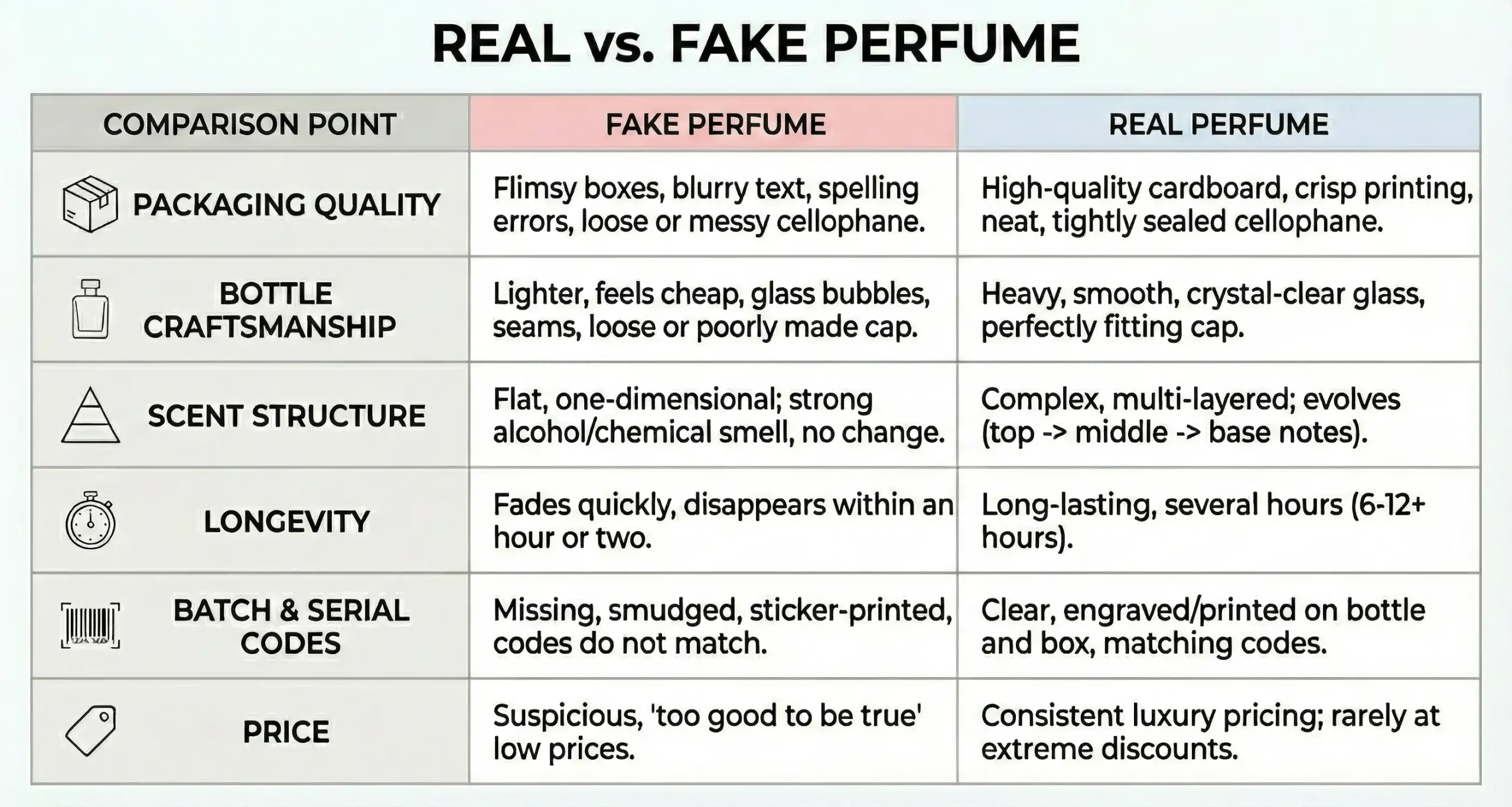
Before exploring the mechanics of batch code verification, it is worth understanding precisely what is at stake when you unknowingly purchase a counterfeit fragrance. The risk is not simply that you spent $150 on something that smells mediocre for two hours. Counterfeit fragrances have been found to contain DEHP, classified by the Environmental Protection Agency as a probable human carcinogen, as well as urine — and have been known to cause serious skin rashes.
Forensic chemist Dr. Sarah Mitchell, who has spent a decade analysing counterfeit cosmetics for the FDA, describes how counterfeiting has evolved: “Ten years ago, you could spot a fake fragrance from across the room — wrong fonts, cheap bottles, obviously synthetic smells. Today, we see counterfeits that are so close to the original that the only way to detect them is through detailed chemical analysis.”
The specific toxic substances found in counterfeit fragrances include methanol and industrial alcohols that legitimate brands never use — these can cause chemical burns and, in extreme cases, blindness if absorbed through skin in sufficient quantities. Heavy metals including lead, mercury, and cadmium are regularly found in counterfeit bottles, likely introduced through contaminated manufacturing equipment. And an incredible 97% of flagged counterfeit cosmetics in recent EU alerts were found to contain BMHCA — a synthetic fragrance ingredient linked to reproductive harm and skin irritation that is completely banned from use in the EU.
Understanding how to authenticate a fragrance is therefore not a hobby for collectors and enthusiasts. It is basic consumer self-protection.
The most heavily counterfeited fragrances are consistently the most popular — because volume of demand makes them the most profitable to fake. Always authenticate with extra diligence when purchasing any of these:
- Dior Sauvage EDT / EDP (the most counterfeited men’s fragrance globally)
- Chanel No. 5 and Coco Mademoiselle
- Creed Aventus (extensive fake market, including fake “batch hunting”)
- Tom Ford Black Orchid and Tobacco Vanille
- Yves Saint Laurent Black Opium and Libre
- Jo Malone London Wood Sage & Sea Salt and Peony & Blush Suede
- Versace Eros and Bright Crystal
- Viktor & Rolf Flowerbomb
- Maison Francis Kurkdjian Baccarat Rouge 540
- Paco Rabanne 1 Million
What Is a Batch Code? Everything You Need to Know
A batch code — also called a lot number — is a short alphanumeric identifier that every legitimate fragrance manufacturer assigns to each specific production run of a product. It is stamped, printed, laser-engraved, or embossed onto both the outer box and the bottle itself, and serves multiple critical functions: quality control, production tracking, safety recalls, shelf life monitoring, and — crucially for consumers — authenticity verification.
Batch Code vs Barcode vs Serial Number: Understanding the Difference
| Identifier | What It Is | Length / Format | Location on Product | Authentication Value |
|---|---|---|---|---|
| Batch Code / Lot Number | Identifies the specific production batch; varies by batch | 3–11 alphanumeric characters (brand-specific format) | Bottom or side of bottle AND bottom or side flap of box — must match on both | Very high — brand-specific format; mismatches and absences are major red flags |
| Barcode (UPC/EAN) | Identifies the product type for retail checkout and inventory | 12–13 digits (UPC-A or EAN-13) | Outer box only | Low — every bottle of the same product shares the same barcode; easily copied by counterfeiters |
| Serial Number / SKU | Identifies the specific product model or catalogue reference | Variable — often longer than batch codes | Box — often near barcode | Low to medium — does not vary by production batch |
| QR Code | Links to brand authentication or product information page | Matrix barcode | Box or bottle label | Medium-High when dynamic and serialised; low when static and easily copied |
The key distinction to remember is this: barcodes are standardised — every 100ml bottle of Dior Sauvage Eau de Toilette sold in the US shares the same barcode. Batch codes, by contrast, vary by production batch and are applied separately to both the box and the bottle, unlike barcodes which only appear on outer packaging. This is precisely why batch codes are so much more valuable for authentication — they are harder to apply consistently and correctly, and easier to get wrong.
What Does a Batch Code Actually Look Like?
Batch codes generally range from 3 to 11 characters and can be numeric, alphanumeric, or a mix of both. Numeric codes include examples like 6211, 91042, or 202305 — these often represent production dates in year-month-day or year plus day-of-year combinations. Alphanumeric codes include examples like 3CE2, A17, FL01, or 62K301 — letters may indicate the factory, production line, or month of manufacture.
Batch codes are not part of a perfume’s decorative design. They are added later using methods like inkjet printing, stamping, laser engraving, or embossing. If the code appears as part of the packaging artwork rather than as a separate identifier, that is a potential red flag. Luxury brands often use laser-engraved or etched batch codes on the bottle itself — this adds an extra layer of security since laser engraving requires specialised equipment that counterfeiters are less likely to access.
Where to Find the Batch Code: Brand-by-Brand Guide
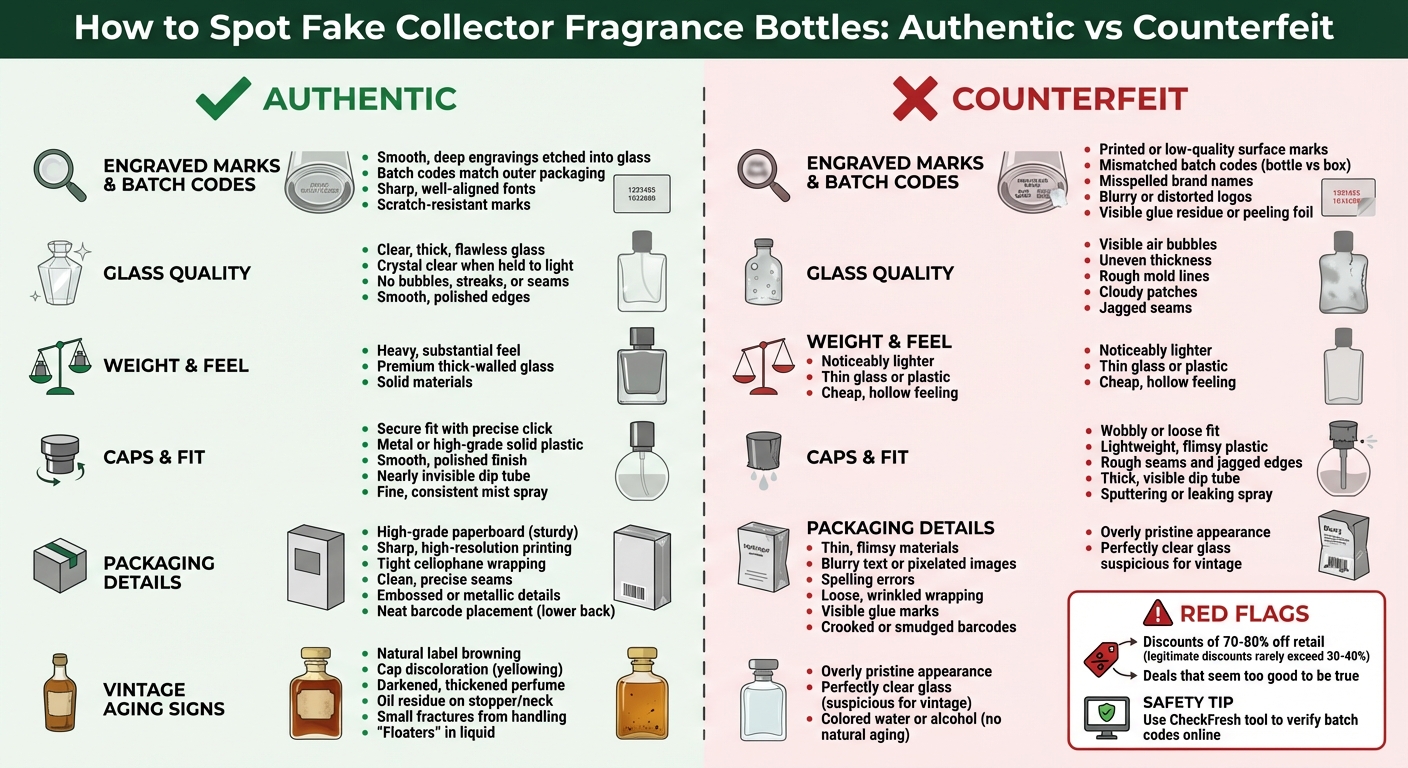
Locating the batch code is the first practical step in authentication — and its position varies meaningfully by brand. Here is a comprehensive reference guide for the most commonly purchased and counterfeited fragrance brands.
| Brand | Batch Code Location (Box) | Batch Code Location (Bottle) | Typical Format | Real Example |
|---|---|---|---|---|
| Christian Dior | Bottom or side flap; separate from barcode | Base of glass, laser-engraved or stamped | 3–6 alphanumeric characters; e.g. digit + letter + two digits | 3W01, 1N02, 8R260, ZL1 |
| Chanel | Bottom of box; sometimes on cellophane | Back of bottle near the base; can be faint — use a torch | 4-digit numeric code; repeats on an 8-year cycle (requires updated database to decode) | 4 digits, e.g. 2315 |
| Tom Ford | Bottom of box, near barcode area | Base of bottle, often stamped | Short alphanumeric, 4–6 characters | FL01, 3CE2 |
| Creed | Side flap or bottom of box | Bottom of bottle, stamped or etched | Alphanumeric, variable length; Aventus batches heavily documented by community | 21P01 (Aventus 2021, batch 01) |
| Jo Malone London | Bottom of box | Bottom of bottle | Alphanumeric, 4–7 characters | Variable; cross-check on CheckCosmetic.com |
| Yves Saint Laurent | Side or bottom of box | Base of bottle | Alphanumeric, 4–6 characters; similar style to Dior (L’Oréal group format) | 4B02, 3K01 |
| Guerlain | Bottom or side flap | Base of bottle | Post-2000: alphanumeric, e.g. 1A01. Pre-2000: non-standardised; requires specialist tables | 1A01, 3C02 |
| Hermès | Bottom of box | Base or back of bottle | Short alphanumeric | Cross-check on Batchcode.org |
| Giorgio Armani | Bottom or side of box | Base of bottle | Alphanumeric, typically 4–6 characters | Cross-check on CheckFresh.com |
| Calvin Klein | Bottom of box | Bottom of bottle (4-digit numeric) | 4-digit numeric code | 6211, 7304 |
Batch codes on dark glass bottles and matte-finish boxes can be extremely difficult to read under normal lighting. Here are the most effective techniques:
- Torch / flashlight at an angle: Hold your phone torch parallel to the bottle base and tilt slowly — etched codes become visible as light catches the engraving at oblique angles
- Smartphone macro camera: Use portrait mode or a dedicated macro camera app to photograph the base of the bottle — zoom in on the photo after shooting to read codes invisible to the naked eye
- Magnifying glass: The most reliable physical tool for reading ink-printed codes on matte packaging
- Check the cellophane: Some Dior and Fahrenheit batches were historically printed directly on the outer cellophane — check before discarding the wrap
How to Read and Decode Batch Codes: The System Explained
Once you have located the batch code, the next step is decoding it — understanding what the code reveals about when and where the fragrance was produced. This is where the intelligence of the system becomes clear, and where the limitations of counterfeit operations become most exposed.
Common Batch Code Formats Used by Major Brands
There is no universal standard — each brand uses its own system. However, many brands follow similar patterns. Julian Calendar codes use the format year + day of year (e.g., 5234 could mean the 234th day of 2015 or 2025). Year + Week/Month codes use a digit for the year followed by a code for the month or week — for example 5A1 for 2015, January, batch 1, with letters often representing months (A=January, B=February, etc.). Some brands use a more direct date incorporation approach (e.g., 25D01 for 2025, April 1st).
Decoding Dior Batch Codes in Detail
Dior is among the most counterfeited fragrance houses and also the most extensively documented for batch code analysis. Understanding Dior’s system in detail equips you for the most common authentication challenge in the market:
| Position in Code | What It Represents | How to Read It | Example: “3W01” |
|---|---|---|---|
| First character (digit) | Last digit of the production year | Single number (0–9); cross-reference with known production timeline of fragrance to determine which decade | “3” = year ending in 3 (e.g., 2013 or 2023) |
| Second character (letter) | Month of production (post-2008 system) | Post-2008: N=Jan, P=Feb, Q=Mar, R=Apr, S=May, T=Jun, U=Jul, V=Aug, W=Sep, X=Oct, Y=Nov, Z=Dec (letter O not used). Pre-2008: A=Jan through M=Dec (letter I not used) | “W” = September (post-2008 system) |
| Third and fourth characters (digits) | Sub-batch or production run identifier | Numeric identifier for the specific batch within that month | “01” = first batch of that production month |
So the code “3W01” on a modern Dior fragrance decodes as: produced in September of a year ending in 3 (i.e., 2013 or 2023), batch number 01. Cross-referencing with the fragrance’s known production history — when it was first launched, when major reformulations occurred — allows you to determine which year is plausible and whether the code is internally consistent with the product and its packaging style.
The Best Free Batch Code Verification Tools in 2026
You do not need to memorise brand-specific decode tables to verify a batch code. Three free online tools handle the decoding automatically — and using all three in combination gives the most reliable result.
| Tool | URL | Brands Covered | What It Shows | Best For |
|---|---|---|---|---|
| CheckFresh.com | checkfresh.com | Major luxury conglomerates: Coty, L’Oréal, Parfums Christian Dior, Shiseido, Chanel, Tom Ford, Creed, Byredo, MFK, Xerjoff and more | Manufacturing date decoded from batch code | Designer and mainstream luxury brands; quick manufacturing date check |
| CheckCosmetic.com | checkcosmetic.net | 1,000+ brands across 27 countries; includes luxury, niche, and commercial fragrance and cosmetics | Manufacturing date, estimated shelf life, expiration date, and safety/freshness status | Widest brand coverage; shelf life and safety assessment in addition to date decoding |
| Batchcode.org | batchcode.org | 500+ brands including Acqua di Parma, Amouage, Byredo, Chanel, Creed, Dior, Jo Malone, Le Labo, Louis Vuitton, MFK, Parfums de Marly, Tom Ford, Xerjoff | Manufacturing date and product age in years and months; updated database | Niche and luxury fragrance specialists; growing database continuously updated |
| BatchCodeChecker.org | batchcodechecker.org | 3–12 character codes for mainstream brands including Chanel, Dior, Tom Ford and more; free, no registration | Manufacturing date; designed for straightforward and precise results | Quick second-check; useful when primary tools return no result |
- Locate the batch code on the box: Check the bottom, side flap, and back panel. It is a short (3–11 character) alphanumeric string, separate from the 12–13 digit barcode and any catalogue reference numbers.
- Locate the batch code on the bottle: Check the base of the glass, the back lower edge, and any labelling. The code on the bottle must exactly match the code on the box. If they don’t match — or one is missing — this is a strong indicator of counterfeiting.
- Photograph the code: Use your smartphone macro camera for precision. This also gives you a reference record of the code for later comparison.
- Enter the code at CheckFresh.com: Select the brand, enter the batch code, and note the manufacturing date returned. Does the date make sense? Is the fragrance old enough for this date to be plausible?
- Cross-check at CheckCosmetic.com or Batchcode.org: Enter the same code on a second platform to confirm the manufacturing date. If the two results contradict each other or one platform returns no result, investigate further before using the fragrance.
- Evaluate the result in context: A batch code that decodes to a manufacturing date years before the fragrance was even launched — or one that doesn’t match the known format for the brand — is a significant red flag. A code that returns a recent, plausible manufacturing date and matches between bottle and box is a strong positive authentication signal.
Beyond Batch Codes: The Complete Authentication Checklist
As sophisticated counterfeiters may replicate external details like barcodes and packaging design but often overlook subtler aspects such as bottle weight or the complexity of the scent itself, batch code verification should always be combined with a broader authentication assessment. Here is the complete checklist.
Packaging Authentication
| Check Point | Authentic Indicator | Counterfeit Red Flag |
|---|---|---|
| Cellophane wrap | Clear, tight, professionally sealed; perforated pull-tab; smooth without creases | Absent entirely; or loose, thin, and unevenly applied — often with visible bubbles or wrinkles |
| Box printing quality | Sharp, precise text and logo with no pixelation; colours accurate to official brand assets; matte or gloss finish consistent with brand standards | Blurry or slightly fuzzy printing; colour variations from official imagery; spelling errors or transposed letters |
| Box construction | Rigid, high-quality cardboard; clean, uniform gluing with no excess adhesive; fitted internal mount or insert card supporting the bottle | Flimsy or thin cardboard; excessive internal glue; missing inner support card; loose bottle movement inside box |
| Batch code on box | Clean, precisely applied, not glued on separately; consistent with brand’s known format; not printed as part of the decorative design | Sticker applied over original area (covering a different code); printed as decorative text; absent; or format inconsistent with brand standard |
| Ingredient / legal text | Complete, correctly formatted, INCI-standard ingredient list; brand contact details accurate; country of origin correct | Abbreviated, missing, or incorrect ingredient list; wrong country of manufacture; missing INCI names |
Bottle Authentication
| Check Point | Authentic Indicator | Counterfeit Red Flag |
|---|---|---|
| Glass quality | Heavy, flawless glass; no bubbles, seams, or distortions; consistent thickness; weight matches official specifications | Lighter than expected; visible bubbles or seam lines; uneven glass thickness; sharp edges where mould met |
| Spray nozzle | Smooth, precise mechanical click; consistent fine mist; nozzle surface polished and shiny | Stiff or loose actuation; uneven or spluttering spray; nozzle surface matte or blurry-looking |
| Batch code on bottle | Matches box code exactly; laser-engraved or precisely stamped; not on an adhered sticker | Different from box code; on an applied sticker; absent; or in an atypical location (cap, spray nozzle area) |
| Cap and closure | Snaps or threads precisely; weighted and solid; magnetically or mechanically secured with a firm, definite feel | Loose, wobbly, or over-tight; plastic cap feels hollow or cheap; closure has no resistance |
| Juice colour | Colour consistent with official product images; not too pale (excess alcohol) and not too dark (chemical adulteration) | Unusually pale or colourless when the original has a characteristic tint; or unusually dark amber when the original is light |
Scent Authentication
The scent itself is your final and often most definitive authentication check. Genuine perfumes unfold in layers — top, heart, and base notes — while counterfeits often have a flat, overly alcoholic smell that fades quickly.
- Top note check (0–5 minutes): Does the opening smell complex, multi-dimensional, and consistent with the fragrance’s known character? Counterfeits often get the opening “close” but with a harsh or metallic edge from industrial alcohol
- Longevity check (30 minutes): Authentic EDPs last 6–12 hours; authentic EDTs 3–5 hours. Fake perfumes typically fade within 2–4 hours regardless of the claimed concentration level.
- Heart note check (60 minutes): Does the fragrance evolve? Genuine fragrances develop through distinct phases. A counterfeit that smells the same at 60 minutes as it did at 5 minutes has no authentic heart note structure
- Skin reaction check: Any immediate burning, itching, redness, or unusual skin sensation after application is a serious warning sign — stop use immediately and wash the area thoroughly. Authentic fragrances may cause sensitivity in specific individuals, but immediate reactions are rare and should always prompt investigation
Where to Buy Authentic Perfumes: A Safe Source Guide
Authentication is most important when you have no control over the supply chain — i.e., when buying from third-party sellers, online marketplaces, discount retailers, or social media. The most reliable way to avoid counterfeits entirely is to buy from sources with verifiable, direct brand relationships.
| Source Type | Risk Level | Notes |
|---|---|---|
| Brand’s official website or boutique | Lowest risk ✅ | Direct from source; no supply chain intermediaries; the gold standard for authenticity |
| Authorised department stores (Sephora, Nordstrom, Harvey Nichols, El Corte Inglés, etc.) | Lowest risk ✅ | Purchase directly from authorised retail counters; brand-managed stock with full supply chain traceability |
| Authorised online retailers (brand-approved; LVMH-verified, etc.) | Low risk ✅ | Check brand websites for lists of authorised online stockists in your region before purchasing |
| Amazon — “Sold by [Brand]” directly | Low risk ✅ | Only when the brand itself is the seller — not third-party sellers fulfilled by Amazon |
| Amazon — Third-party sellers (“Fulfilled by Amazon” or third party) | Medium-High risk ⚠️ | As Amazon is a marketplace driven by vendors, there is always a chance of getting a fake perfume. Always check vendor ratings and reviews. Still authenticate upon receipt |
| Social media (TikTok Shop, Instagram shops, Facebook Marketplace) | Very High risk ❌ | Black Friday, Singles’ Day, Christmas, and New Year’s Eve are peak periods during which counterfeit perfume dupes are massively marketed on social media — particularly on platforms including Temu, Shein, and AliExpress. |
| Discount retail, street vendors, market stalls | Very High risk ❌ | If the price is 40–60% below the official retail price for a luxury fragrance, that discount is almost never legitimate — it signals counterfeit, diverted, or reformulated product |
Frequently Asked Questions
Q: If the batch code checks out on CheckFresh.com, does that guarantee my perfume is authentic?
Not with absolute certainty — but it is a very strong positive signal. The limitation is that a sophisticated counterfeiter can copy an authentic batch code they observed on a genuine bottle. However, combining a valid batch code decode with matching codes on bottle and box, correct packaging quality, appropriate scent complexity, and normal longevity creates a multi-point authentication that is extremely difficult to fake consistently. As while a valid batch code doesn’t guarantee authenticity on its own, it is a critical piece of the puzzle — paired with checks on packaging quality, scent, and seller reputation, it can help confirm whether a perfume is genuine or not.
Q: What should I do if I believe I have bought a fake perfume?
Stop using it immediately if you have already applied it to skin, especially if you have experienced any unusual reaction. Document the evidence — photograph the batch codes on both box and bottle, the packaging inconsistencies, and any mismatches. Contact the seller immediately to request a full refund based on inauthenticity; most legitimate platforms (including Amazon) have buyer protection policies that cover counterfeit goods. If you paid by credit card or PayPal, you can also initiate a chargeback dispute. Report the seller to the platform and, where appropriate, to national consumer protection authorities or brand authentication teams — all major fragrance houses have dedicated anti-counterfeiting departments that accept consumer reports.
Q: My batch code returns a date from several years ago. Does that mean my perfume is fake?
Not necessarily. An old manufacturing date simply means the bottle has been in inventory — possibly at a retailer, in a warehouse, or in private storage — since it was produced. Fragrances typically have a shelf life of 3–5 years when stored correctly (away from heat, light, and humidity), so an older batch code is not itself a red flag. It becomes a concern when combined with other issues: a discount price that implies recent production, packaging in a style inconsistent with the production period, or a scent that has degraded significantly. Cross-reference the manufacturing date with when the specific fragrance was first launched — if the code decodes to a date before the fragrance existed, that is an immediate and definitive red flag.
Q: Do niche and independent fragrance brands use batch codes the same way as designer houses?
Yes, all legitimate fragrance manufacturers — including indie and niche brands — are legally required to include batch codes on their products for regulatory traceability and recall purposes. However, niche brands are less well-covered by the mainstream batch code decoder databases, which primarily focus on major luxury houses. For niche fragrances like Creed Aventus, Le Labo, Byredo, and Maison Francis Kurkdjian, Batchcode.org has the strongest current coverage. For very small indie brands, contacting the brand directly with your batch code is often the most reliable authentication route — legitimate small producers will always be able to confirm whether a given batch code corresponds to their production records.
Q: Can I authenticate a perfume using just the barcode on the box?
Barcodes are a much weaker authentication tool than batch codes and should not be relied upon as a primary check. As noted throughout this guide, because barcodes are standardised, they are easy for counterfeiters to copy — a fake perfume can carry a real barcode lifted from an authentic product. Barcodes are useful as a supplementary cross-check to confirm the correct product type, but they provide no production-specific information and should never substitute for batch code verification.
The Bottom Line: Two Minutes That Protect Your Health and Your Investment
A counterfeit perfume is not simply a disappointing purchase. At best, it is money wasted on something that will smell wrong and disappear in two hours. At worst, it is a bottle of methanol, industrial alcohol, heavy metals, and unregulated synthetic compounds that you are applying directly to your skin, twice a day, for months. The counterfeit perfume market is now valued at over €3 billion — and counterfeits account for 28% of global perfume sales. The scale of the problem means that everyone who buys fragrance — especially online, especially at a discount, especially from an unverified seller — is at meaningful risk.
The batch code system is not a perfect solution. Sophisticated counterfeiters can and do copy visible codes. But combined with the free verification tools, the physical authentication checklist, and the habit of purchasing from authorised sources, it gives every consumer the ability to dramatically reduce their risk — for free, in under two minutes, before a single drop touches their skin.
Check the code. Match the box. Smell the evolution. Buy from authorised sources. Four steps that separate a great fragrance experience from a potentially dangerous one.
Related Posts from PerfumeLead
- Top 5 American Niche Perfume Brands Redefining “Raw” Scents in 2026 — Niche and indie fragrance brands are among the most frequently counterfeited due to their high prices and limited availability. Learn to authenticate before you invest.
- The Rise of Biotech Sandalwood: Why Ethical Fragrance Is the Future — Understanding ingredient authenticity starts with understanding how legitimate fragrances are formulated — and how biotech is creating more traceable ingredient supply chains.
- What Is “Upcycled Perfume”? How Flower Waste Is Becoming Luxury Scent — The sustainable fragrance movement is also driving better ingredient transparency — a direct antidote to the opaque supply chains that enable counterfeiting.
- How to Choose a Confidence Scent: The Science of Citrus and Woods — Once you know how to authenticate your purchase, explore which fragrance profiles genuinely support confidence and wellbeing through the science of citrus and woody notes.
- A Beginner’s Guide to Perfume Types — New to fragrance? Understanding EDP vs EDT concentrations and note families equips you to recognise when a fragrance’s performance doesn’t match its claimed specification — a useful secondary authentication signal.
Disclaimer: The batch code verification tools referenced in this guide (CheckFresh.com, CheckCosmetic.com, Batchcode.org, BatchCodeChecker.org) are independent third-party platforms not affiliated with PerfumeLead. While every effort has been made to ensure the accuracy of the brand-specific batch code information provided, fragrance houses periodically update their coding systems. Always cross-reference multiple sources and, where in doubt, contact the brand’s official customer service team directly. If you experience any adverse skin reaction after applying a fragrance, discontinue use immediately and consult a healthcare professional.