
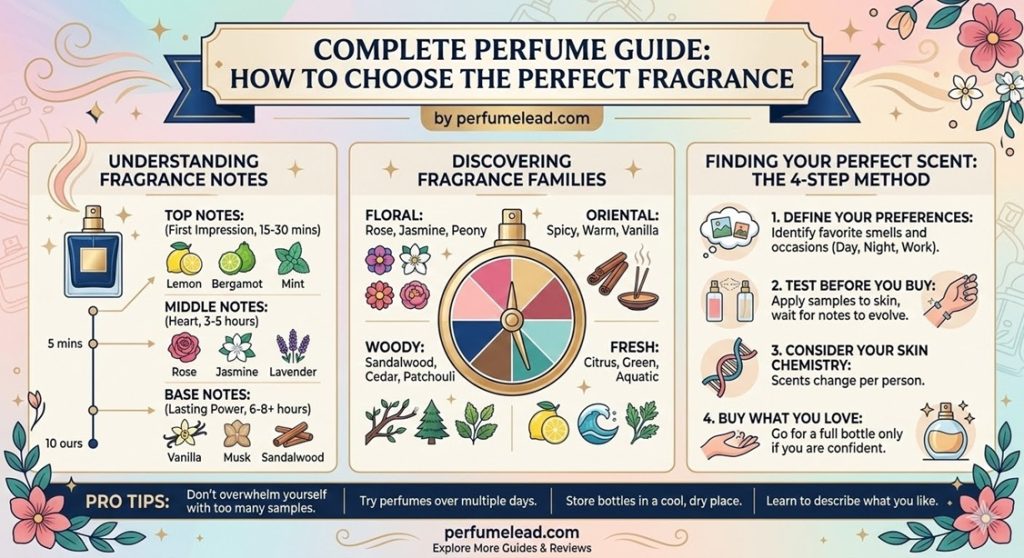
Complete Perfume Guide: How to Choose the Perfect Fragrance
Choosing the perfect fragrance is an art that combines personal preference, practical knowledge, and a touch of chemistry. Whether you’re buying your first perfume or expanding an established collection, understanding the fundamentals of perfumery helps you make informed decisions and find scents that truly resonate with your personality and lifestyle. This comprehensive guide covers everything you need to know—from perfume types and concentrations to manufacturing processes and proper application techniques.
The world of fragrance can seem overwhelming with its complex terminology, countless options, and varying price points. However, with the right knowledge, navigating this world becomes an enjoyable journey of self-discovery. Your signature scent is more than just a pleasant aroma; it’s an invisible accessory that communicates your style, enhances your mood, and creates lasting memories for you and those around you.
Why Choosing the Right Perfume Matters
Perfume is deeply personal. The right fragrance can boost your confidence, evoke cherished memories, and even influence how others perceive you. Studies have shown that scent is strongly linked to memory and emotion, making your choice of fragrance a powerful tool for self-expression.
Beyond personal enjoyment, wearing perfume is a social signal. A well-chosen scent demonstrates attention to detail and sophistication. It can make you more memorable in professional settings, more alluring in romantic situations, and more approachable in social gatherings. Understanding how to select and wear perfume appropriately for different occasions is an essential life skill.
The investment in quality fragrance also deserves consideration. While luxury perfumes can be expensive, understanding concentrations, longevity, and proper application helps you maximize value and choose products that justify their price tags. This guide empowers you to make smart purchasing decisions whether you’re shopping for affordable daily scents or splurging on special occasion fragrances.
Types of Perfumes
Understanding the different types of perfumes is fundamental to making the right choice. Fragrances are categorized primarily by their concentration of perfume oil, which directly affects their intensity, longevity, and price point. Each type serves different purposes and suits different preferences and occasions.
Parfum (Extrait de Parfum) represents the highest concentration, containing 20-30% perfume oil. This luxurious formulation offers the most intense, longest-lasting scent experience, often lingering for 8-12 hours or more. Parfums are typically the most expensive option but require only minimal application. They’re ideal for special occasions, evening wear, or those who want their fragrance to last all day without reapplication.
Eau de Parfum (EDP) contains 15-20% perfume oil concentration, making it the most popular choice for everyday wear. EDPs offer excellent longevity (typically 6-8 hours) with noticeable but not overwhelming projection. They strike the perfect balance between performance and price, making them versatile options for work, social events, and daily activities.
Eau de Toilette (EDT) features 5-15% perfume oil, providing a lighter, fresher scent experience that lasts 3-5 hours. EDTs are perfect for daytime wear, warmer weather, or situations where subtlety is preferred. They’re often more affordable than EDPs and ideal for those who enjoy reapplying fragrance throughout the day or prefer less intense scents.
Eau de Cologne (EDC) contains 2-5% perfume oil, offering a brief, refreshing burst of fragrance that typically lasts 2-3 hours. Traditionally citrus-focused, colognes are perfect for hot weather, post-gym refreshment, or casual daytime activities. Their light nature makes them ideal for fragrance beginners or those who prefer understated scent.
Eau Fraiche has the lowest concentration at 1-3% perfume oil, providing the most subtle fragrance experience. These are essentially scented waters, perfect for those who want the slightest hint of fragrance or need to avoid stronger scents due to sensitivities or workplace requirements.
Learn more about each perfume type and find which concentration suits your needs best.
Difference Between EDT vs EDP
The choice between Eau de Toilette and Eau de Parfum is one of the most common decisions fragrance shoppers face. While both can smell similar in the bottle, they offer distinctly different wearing experiences due to their varying concentrations.
Longevity is the primary difference. EDPs typically last 6-8 hours on skin, while EDTs fade after 3-5 hours. This means EDPs require less frequent reapplication, making them more convenient for long workdays or events where carrying a bottle isn’t practical. However, EDTs’ shorter lifespan can be an advantage if you enjoy switching scents between day and evening or prefer to refresh your fragrance periodically.
Projection and sillage differ significantly. EDPs project more strongly, creating a noticeable scent bubble around the wearer. This makes them ideal for making impressions but potentially overwhelming in close-quarter environments. EDTs stay closer to the skin, creating a more intimate scent experience that’s appropriate for offices, airplanes, and conservative professional settings.
Price considerations often favor EDPs in terms of value. While they cost more upfront, their higher concentration means you use less per application. An EDP might cost 30-50% more than its EDT counterpart but last twice as long, making it more economical over time. However, if you prefer variety and reapplication, EDTs offer more flexibility at a lower initial investment.
Seasonal performance varies between the two. EDPs perform better in cold weather when their heavier concentration can fully develop. EDTs shine in summer heat, where their lighter nature prevents becoming cloying or overwhelming. Many fragrance enthusiasts own both concentrations of favorite scents, using EDP in winter and EDT in summer.
Skin chemistry affects each differently. Dry skin tends to amplify the differences, with EDPs performing significantly better than EDTs. Oily skin holds both types well, potentially making EDTs sufficient for everyday needs. Testing both concentrations on your skin before purchasing is essential, as the same fragrance can smell and perform differently in each formulation.
Understanding these differences helps you choose the right concentration for your lifestyle, budget, and preferences.
EDT vs EDP: Detailed Comparison
Perfume Bottle Sizes
Perfume bottles come in various sizes, and understanding these options helps you make cost-effective purchasing decisions. Standard sizes vary by brand and concentration, but certain norms exist across the industry.
30ml (1 oz) bottles are the smallest standard size, perfect for testing new fragrances, travel, or those who prefer variety over commitment. These sizes offer the highest cost-per-milliliter but minimize financial risk when exploring new scents. They’re also TSA-friendly for carry-on luggage, making them ideal for frequent travelers.
50ml (1.7 oz) bottles represent a popular middle ground, offering enough fragrance for regular use without excessive commitment. This size typically lasts 3-6 months with daily application, making it perfect for seasonal scents or fragrances you enjoy but don’t consider signature worthy.
100ml (3.4 oz) bottles provide the best value for signature scents you wear regularly. The cost-per-milliliter is significantly lower than smaller sizes, and the quantity lasts 6-12 months or more. However, this size represents a larger investment and requires confidence that you’ll enjoy the fragrance long-term.
200ml+ bottles offer maximum value for absolute favorite fragrances. These jumbo sizes are perfect for scents you wear daily and can’t imagine living without. However, perfume does expire eventually (typically 3-5 years after opening), so ensure you can use the quantity before it degrades.
Travel sizes and minis (5-15ml) are excellent for discovery sets, purse carry, or sampling before committing to full bottles. Many brands offer these sizes in gift sets or as promotional items, making them perfect for building a versatile fragrance wardrobe without breaking the bank.
When choosing bottle size, consider your usage patterns, the fragrance’s longevity, and storage conditions. Properly stored perfume maintains quality for years, but heat, light, and air exposure accelerate degradation. Buying larger bottles only makes sense if you can store them properly and use them within their optimal lifespan.
Get the complete breakdown of perfume bottle sizes and find the perfect option for your needs.
How Perfumes Are Made
The creation of perfume is both an art and a science, combining centuries-old traditions with modern technology. Understanding this process deepens appreciation for the fragrances you wear and helps you recognize quality craftsmanship.
Concept and Inspiration begin the journey. Perfumers (called “noses”) start with an idea—a memory, emotion, place, or ingredient they want to highlight. This concept guides every subsequent decision, from ingredient selection to final blending. Some fragrances take years to develop from initial concept to market release.
Ingredient Sourcing involves gathering natural and synthetic materials. Natural ingredients come from flowers, fruits, woods, resins, and spices sourced worldwide. Rose from Bulgaria, jasmine from France, sandalwood from Australia—each origin imparts subtle differences. Synthetic molecules replicate rare or unsustainable natural ingredients, create entirely new scent profiles impossible in nature, and ensure consistency batch to batch.
Extraction Methods transform raw materials into usable fragrance oils. Steam distillation heats plant material to release essential oils, ideal for robust flowers and herbs. Solvent extraction uses chemicals to delicately capture aromas from fragile flowers like jasmine and rose. Expression mechanically presses citrus peels to obtain fresh oils. CO2 extraction uses supercritical carbon dioxide for environmentally friendly, high-quality results.
Blending and Formulation is where the perfumer creates the fragrance accord. Using the fragrance pyramid concept, they balance top, middle, and base notes to create harmonious evolution. This process requires extensive training, exceptional olfactory memory, and artistic sensibility. A single fragrance might contain dozens of ingredients in precise proportions.
Aging (Maturation) allows the blended fragrance to develop fully. Like fine wine, perfumes improve with age as molecules interact and integrate. This process can last weeks to months, during which the scent profile may change significantly. Quality fragrances are never rushed to market before proper aging.
Dilution and Bottling transforms the concentrated perfume oil into consumer products. The oil is mixed with alcohol (typically ethanol) and sometimes water to achieve the desired concentration—Parfum, EDP, EDT, etc. This mixture is then filtered, quality-tested, and bottled in carefully designed packaging that protects the fragrance from light and air.
Understanding this craftsmanship helps justify the cost of quality fragrances and distinguishes artisanal perfumery from mass-market alternatives.
How to Choose Your Perfect Fragrance
Selecting a perfume involves more than simply choosing a pleasant smell. Follow this systematic approach to find fragrances that truly suit you.
Identify your preferences by examining what you already enjoy. Do you gravitate toward fresh, clean scents or warm, cozy aromas? Are you drawn to florals, woods, spices, or gourmands? Your existing preferences in candles, lotions, and even foods hint at fragrance families you’ll enjoy.
Consider your lifestyle when selecting scents. Office workers might prefer subtle, inoffensive fragrances, while creative professionals can experiment with bolder choices. Active lifestyles demand fresh, energizing scents, while romantic personalities might prefer sensual, warm fragrances. Your daily activities should inform your fragrance choices.
Test properly before buying. Never purchase based on paper strips alone. Spray on your skin and wait several hours to experience the full dry-down. Test no more than three fragrances per shopping trip to avoid olfactory fatigue. Visit stores at different times, as your sense of smell varies throughout the day.
Understand seasonality. Light, fresh scents work best in spring and summer, while warm, rich fragrances excel in fall and winter. Some versatile scents work year-round, but building a seasonal wardrobe ensures appropriate options year-round.
Factor in your skin chemistry. Oily skin amplifies and extends fragrances, while dry skin causes faster evaporation. Test how fragrances develop on your specific skin before committing. What smells amazing on a friend might not work for you due to these individual differences.
Start with discovery sets when exploring new brands or families. These sample collections let you experience multiple scents affordably before investing in full bottles. Many niche and luxury brands offer these sets, making high-end exploration accessible.
Get more detailed guidance on selecting the perfect fragrance for your unique needs.
Beginner’s Guide to Perfume Types
Perfume Application Tips
Proper application maximizes your fragrance’s performance and ensures appropriate projection for different situations.
Apply to pulse points where blood flow generates warmth that helps diffuse scent. These include wrists, neck, behind ears, inner elbows, and behind knees. For more subtle projection, apply to lower body pulse points (behind knees, ankles) so scent rises gently.
Don’t rub your wrists together after applying. This friction breaks down fragrance molecules and alters the scent profile. Instead, let perfume dry naturally on skin.
Layer for longevity. Use matching shower gel, lotion, and fragrance to create a foundation that extends wear time. unscented moisturizer applied before perfume also helps anchor scent.
Spray on clothing and hair for additional longevity. Fabrics often hold fragrance longer than skin. However, test on hidden areas first, as perfume can stain delicate fabrics.
Adjust quantity for concentration. Parfums require only 1-2 dabs. EDPs work best with 2-3 sprays. EDTs can handle 3-4 sprays for equivalent presence. More isn’t always better—overapplication can overwhelm and offend.
Consider the occasion. Apply lighter for work and close-quarter situations. Be more generous for outdoor events, evenings, or large spaces where scent needs to travel. When in doubt, apply less—you can always add more, but removing excess is impossible.
Storage and Care
Proper storage maintains fragrance quality and extends lifespan. Perfume is sensitive to environmental factors that can degrade its delicate molecular structure.
Keep away from light. UV rays break down fragrance molecules, altering scent and color. Store bottles in original boxes or dark drawers. Clear bottles are particularly vulnerable—extra care is essential.
Avoid heat and humidity. Bathrooms are terrible storage locations due to temperature fluctuations and moisture. Ideal storage is cool, dry, and consistent—around 60-70°F (15-21°C).
Minimize air exposure. Oxygen oxidizes fragrance, degrading top notes first. Keep bottles tightly closed and consider decanting frequently used fragrances into smaller atomizers to limit air contact with the main supply.
Use within 3-5 years. While perfume doesn’t spoil like food, it does degrade. Citrus-heavy fragrances deteriorate fastest, while orientals and woods last longest. If color changes significantly or scent smells “off,” it’s time to replace.
Travel carefully. Extreme temperatures in cars and airplanes damage fragrance. Never leave perfume in vehicles. For travel, use small decants rather than exposing full bottles to temperature fluctuations.
Frequently Asked Questions
How do I know which perfume concentration is right for me?
Choose based on your needs: EDP for all-day wear and stronger projection, EDT for lighter, more subtle presence and frequent reapplication, Parfum for special occasions and maximum longevity. Consider your skin type (dry skin benefits from EDP), lifestyle (office workers often prefer EDT), and climate (EDT for hot weather, EDP for cold).
Why is perfume so expensive?
Quality perfume involves costly ingredients (natural absolutes can cost thousands per pound), extensive development time, skilled labor, aging processes, and luxury packaging. The concentration also affects price—higher oil content means more expensive formulations. However, cost-per-wear often makes quality fragrances good value compared to cheaper alternatives requiring frequent reapplication.
Can perfume expire?
Perfume doesn’t expire like food but degrades over time. Most last 3-5 years when properly stored. Signs of degradation include color changes, altered scent (especially sour or metallic notes), and weakened projection. Citrus fragrances deteriorate fastest; orientals and woods last longest.
How many perfumes should I own?
There’s no right number, but versatility suggests at least 3-5: a signature daily scent, something for evenings/special occasions, a seasonal option for summer, and perhaps something experimental. Quality matters more than quantity—a few loved fragrances serve you better than many unused bottles.
Is it better to buy perfume online or in-store?
In-store testing is essential for new purchases, as skin chemistry significantly affects how fragrances smell. However, online shopping offers better prices and access to niche brands. Best practice: test in-store, then purchase online once you know what works for you. Many online retailers also offer sample programs for risk-free exploration.
Your Fragrance Journey Starts Here
Choosing the perfect perfume is a personal journey of discovery. With the knowledge from this guide, you’re equipped to navigate the fragrance world confidently, making informed decisions that lead to scents you’ll love wearing.
Remember that rules are guidelines, not absolutes. The best perfume is always the one that makes you feel confident, happy, and authentically yourself. Use this information as your foundation, but trust your nose and instincts above all.
Continue exploring our detailed guides to deepen your fragrance knowledge and discover scents that perfectly match your unique personality and style.
Ready to explore more? Check out our detailed guides on types of perfumes, EDT vs EDP differences, bottle sizes, and our beginner’s guide to perfume types to continue your fragrance education!

:quality(85):extract_cover()/2022/12/12/951/n/1922153/620868d86397a1f6a2f190.46411164_.jpg "5 Top TikTok Viral Perfumes You Need to Try")