Types of Scents: The Complete Fragrance Guide You Actually Need
From sun-warmed citrus to deep midnight woods — scent is the one sense that bypasses logic entirely and speaks straight to memory. Whether you’re building a fragrance wardrobe, hunting for your first signature perfume, or just trying to understand why you love certain smells and can’t stand others, this guide breaks down every major type of scent with clarity, depth, and just enough science to make it fascinating.
What Are Scent Families — and Why Do They Matter?
Scent families are organized groups of fragrances that share similar aromatic characteristics, raw materials, and emotional qualities. Think of them like music genres — just as you might describe a song as jazz, classical, or hip-hop, a perfume belongs to a broader fragrance category that defines its overall mood and direction.
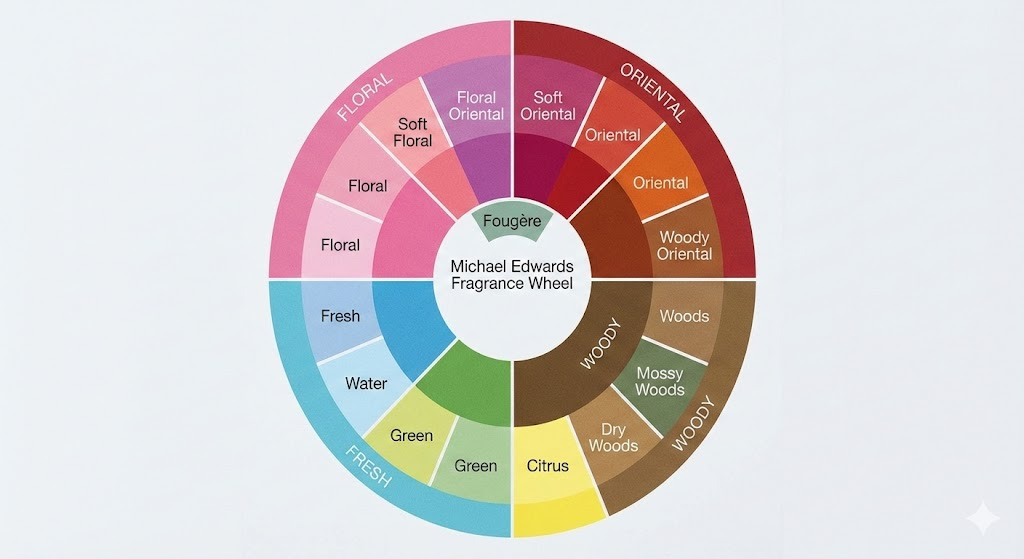
The modern fragrance classification system most people use today is built on Michael Edwards’ Fragrance Wheel, developed in 1983 and continuously updated. This circular diagram organizes the four primary scent families — Floral, Fresh, Woody, and Amber — and arranges their subfamilies around the wheel so that adjacent groups share olfactory characteristics and blend harmoniously together.
Understanding scent families empowers you to shop smarter, layer fragrances more effectively, and articulate exactly what you love (or hate) about a particular smell. It’s the difference between picking blindly off a shelf and walking into a perfumery with real vocabulary and self-knowledge.
Understanding Fragrance Notes: Top, Heart & Base
Before diving into scent types, you need to understand fragrance notes — the layered structure that makes a perfume unfold differently over time. Every fragrance you wear is essentially a three-act story happening on your skin.
Top Notes (Head Notes)
Top notes are the first impression. They greet your nose within the first 30 seconds of application, creating that instant burst of scent that influences whether you pick up a bottle in the first place. These molecules are the lightest and most volatile, which is why they evaporate within 15 to 30 minutes. Common top notes include citrus elements like bergamot and lemon, light herbs like basil, and bright fruits.
Heart Notes (Middle Notes)
Once the top notes fade, the heart notes emerge — and these are the true soul of any fragrance. They represent the dominant character of the perfume and can last anywhere from two to five hours. Floral accords, spices, and soft fruits are the most common heart note ingredients. Rose, jasmine, ylang-ylang, cardamom, and cinnamon all live here.
Base Notes
Base notes are the long-lasting foundation that anchors the entire fragrance. Rich, deep, and often warm, they begin to emerge after about 30 minutes and can persist on skin and fabric for 6 to 12+ hours. Sandalwood, vetiver, musk, vanilla, amber, and oakmoss are classic base note materials. These are what you smell on a scarf hours after wearing a perfume.
| Note Layer | When You Smell It | Duration | Common Examples |
|---|---|---|---|
| Top Notes | Immediately on application | 15–30 minutes | Bergamot, lemon, grapefruit, basil, mint |
| Heart Notes | After top notes fade | 2–5 hours | Rose, jasmine, cardamom, geranium, clove |
| Base Notes | 30+ minutes after application | 6–12+ hours | Sandalwood, musk, vanilla, vetiver, amber |
The Complete Fragrance Wheel
This image provides a full view of Michael Edwards’ Fragrance Wheel. It shows the four main families (Floral, Oriental, Woody, Fresh) and their respective sub-families, all arranged around a central Fougère note. The colors are distinct for each family, making it easy to identify the different olfactory groups.
The Four Core Fragrance Families Explained
Whether you’re exploring perfumery for the first time or deepening an existing obsession, the four principal fragrance families provide your foundational roadmap. Every perfume, from a €15 drugstore bottle to a $600 niche creation, belongs primarily to one of these families — or to a hybrid blend of two.
🌸 Floral Scents — The World’s Most Popular Fragrance Family
Floral fragrances are the most widely worn category on the planet, and for good reason. They capture one of nature’s most universally beloved sensory experiences — the smell of blooming flowers. But within this broad category, there is extraordinary variety. From the light, dewy freshness of lily of the valley to the heavy, narcotic intensity of tuberose, floral scents span a massive emotional range.
What Defines a Floral Scent?
At their core, floral fragrances feature prominent notes of flowers as their dominant characteristic. Rose, jasmine, lily, peony, violet, and iris are among the most common. These scents typically evoke femininity, romance, elegance, and natural beauty — though modern perfumery has pushed floral scents into surprisingly edgy, unisex, and even dark territories.
Floral Subfamilies
Soft Floral: Light, powdery floral compositions that feel gentle and comforting. Think iris, heliotrope, and soft musky roses. These are understated and intimate — scents that feel like a whisper rather than a statement.
Floral Oriental (Floriental): Where floral notes meet the warmth and spice of oriental ingredients. Orange blossom, jasmine, and ylang-ylang combined with vanilla, benzoin, or amber create something simultaneously romantic and sultry.
White Floral: A beloved subcategory built around white flowers — gardenia, tuberose, orange blossom, jasmine, and frangipani. These are often the most intoxicating and narcotic of all florals, opulent and deeply sensual.
Fresh Floral: Light, airy combinations of floral notes with citrus or aquatic elements. Bright and easy-wearing, perfect for spring and everyday use.
Famous Floral Fragrances
Chanel No. 5 remains the iconic benchmark of the floral aldehyde category. Dior’s Miss Dior is a classic fresh floral chypre. Marc Jacobs Daisy exemplifies the sunny, carefree fresh floral. For white florals, Serge Lutens’ Tubéreuse Criminelle is legendary.
The Four Main Families
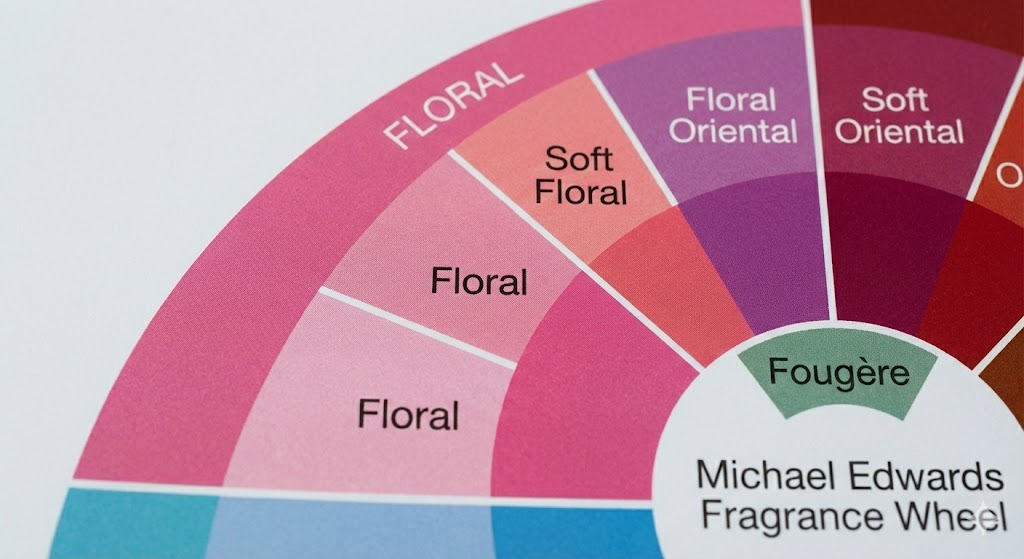
This image is a close-up of the Fragrance Wheel, highlighting the four main families: Floral, Oriental, Woody, and Fresh. It visually separates these four main sections, making it easier to understand the primary categorization of the wheel.
🍋 Fresh Scents — Clean, Bright & Endlessly Wearable
Fresh fragrances are exactly what they sound like — they smell clean, bright, and alive. They evoke the feeling of morning air, ocean breezes, citrus groves, and herb gardens after rain. This family is defined less by a single dominant material and more by a shared quality of vitality and cleanliness.

Citrus Scents
Citrus fragrances are built on zesty, bright ingredients like bergamot, lemon, lime, orange, mandarin, and grapefruit. These are among the most uplifting and universally flattering scent types, making them perennial bestsellers. Citrus notes are almost always found in the top notes of a fragrance since they evaporate quickly — which means purely citrus-forward perfumes tend to have shorter longevity on skin unless anchored with a musky or woody dry-down.
Best-known citrus fragrances include Chanel’s Allure, Acqua di Gio by Giorgio Armani, and 4711 Original Eau de Cologne.
Aquatic / Marine Scents
Aquatic fragrances, sometimes called “ozonic” or “marine” scents, bottle the feeling of being near water. Sea spray, ocean air, and clean rain are the emotional territories here. These fragrances rely on synthetic molecules — particularly Calone, discovered in the 1950s — to recreate that wet, salty, open-air feeling that doesn’t exist in nature as an extractable oil. Davidoff’s Cool Water popularized this genre in 1988 and defined mainstream masculinity in fragrance for decades afterward.
Green Scents
Green fragrances smell like cut grass, crushed leaves, stems, and herbs. They’re botanical, earthy, and often photorealistic — like pressing your face into a bouquet and inhaling the green parts, not just the blooms. Violet leaf, tomato leaf, galbanum, and cucumber notes are hallmarks of the green scent type.
Aromatic Fresh (Fougère-Adjacent)
Herbal and aromatic fresh fragrances lean on lavender, rosemary, mint, thyme, and sage to create something simultaneously clean and complex. This type is traditionally associated with masculine grooming products but has expanded significantly into unisex territory.
🌲 Woody Scents — Warm, Grounded & Mysteriously Compelling
Woody fragrances are built on the warm, earthy, sophisticated scents of trees, roots, and resins. They convey depth, confidence, and a certain grounded elegance that no other fragrance family quite replicates. Once considered predominantly masculine territory, woody scents today appear across all genders and styles — from minimalist clean wood compositions to dark, resinous forest accords.
Key Woody Ingredients
Sandalwood: Perhaps the most beloved wood note in perfumery. True Mysore sandalwood from India is creamy, smooth, and softly sweet — almost milky. It’s warm without being heavy and blends seamlessly with almost every other note. Sandalwood has been used in rituals, incense, and beauty preparations for over 4,000 years.
Cedarwood: Dry, pencil-shaving-like, and clean. Atlas cedarwood from Morocco has a slightly powdery quality; Virginia cedarwood is more angular and dry. Cedarwood is one of the most versatile base notes in perfumery — it works in florals, citrus compositions, and full-on orientals.
Vetiver: One of the most complex raw materials in all of perfumery. Vetiver is the root of a grass plant from Haiti, India, or Java — and each origin produces a dramatically different scent. Haitian vetiver is smoky and earthy; Indian vetiver is sweeter; Indonesian vetiver is the most medicinal. All versions share a fascinating cool-earthy quality that perfumers adore.
Oud (Agarwood): The “black gold” of perfumery. Oud is formed when the Aquilaria tree becomes infected with a specific mold and produces a dark, resinous heartwood in self-defense. The resulting material smells smoky, animalic, leathery, and intensely complex. Deeply rooted in Middle Eastern and South Asian culture, oud has exploded in popularity in Western perfumery over the last 15 years.
Patchouli: Earthy, sweet, and slightly damp, patchouli is one of the most polarizing notes in perfumery. Adored in bohemian and oriental compositions, it serves as both a fixative and a protagonist. High-quality aged patchouli is nothing like the patchouli oil associated with the 1970s counterculture.
Woody Subfamilies
Mossy Woods: These compositions incorporate oakmoss and other earthy-mossy materials that give a forest-floor quality — damp, green, and slightly sweet. This is the foundation of classic chypre fragrances.
Dry Woods: Smoky, leathery, and often incorporating cedar or birch tar. These fragrances feel austere and confident — less warm than oriental woods and more architectural.
Woody Oriental: A bridge category blending woody depth with the richness and spice of oriental fragrances. Think sandalwood + amber + vanilla + incense. Deeply sensual and long-lasting.
A Detailed Look at the Floral Family
This image provides a close-up of the “Floral” family and its sub-families, as seen in the previous images. It shows the detailed segmentation within a main family, with labels like “Floral,” “Soft Floral,” and “Floral Oriental” clearly visible.
🌙 Amber (Oriental) Scents — Rich, Sensual & Deeply Evocative
The amber family — historically known as “oriental” before the fragrance industry began moving away from that culturally loaded term — is defined by warmth, richness, and a certain luxurious sensuality. These fragrances feel like velvet on the skin. They’re built from resins, spices, sweet notes, and exotic ingredients that evoke candlelit evenings, spice markets, and the richness of the ancient world.
Defining Amber Ingredients
Vanilla and benzoin are the sweet, creamy heart of most amber compositions. Labdanum (a resin from rock rose) provides the true “amber” quality — warm, animalic, and slightly sweet. Add cardamom, cinnamon, clove, incense, myrrh, and orchid and you have the full palette of the amber family.
Amber Subfamilies
Soft Amber: The gentler end of the family — vanilla, benzoin, iris powder, and soft musks. These are approachable and warm without being heavy. Perfect for transitional seasons.
Floral Amber: When the oriental warmth is softened and brightened by prominent floral notes — rose, jasmine, or orange blossom alongside amber and spice. Classic examples include Yves Saint Laurent’s Opium and Lancôme’s La Vie Est Belle.
Woody Amber: The deepest and most complex subcategory — sandalwood, oud, resins, and spices creating a multi-dimensional warmth. Evening wear par excellence.
Gourmand Amber: Sweet, food-like notes — chocolate, caramel, tonka bean — combined with amber’s warmth. The modern gourmand phenomenon grew directly from this territory.
Beyond the Big Four: Specialty Scent Categories
While the Fragrance Wheel’s four families cover most perfumery, several additional categories have become important enough in their own right to deserve dedicated consideration. These specialty types have defined iconic fragrances and entire generations of scent culture.
🍫 Gourmand Scents — Dessert for Your Skin
Gourmand fragrances (from the French word for a lover of fine food) smell unmistakably edible. Chocolate, coffee, caramel, cookie dough, candied fruit, honey, and whipped cream are the vocabulary here. The category was essentially invented in 1992 when Thierry Mugler’s Angel introduced a revolutionary combination of ethyl maltol (cotton candy), patchouli, and chocolate that divided critics but became one of the bestselling perfumes in history.
Modern gourmands range from the playfully sweet (Ariana Grande’s Cloud, with its lavender-vanilla-coconut softness) to deeply complex culinary meditations from niche houses like Etat Libre d’Orange or Commodity. The key is that the scent is enjoyable in a way that activates the same neural pathways as enjoying a delicious meal.
🌿 Aromatic Scents — Herbs, Spices & Complexity
Aromatic fragrances are defined by prominent herbal and spice notes traditionally used in cooking: lavender, rosemary, thyme, sage, basil, chamomile, mint, and marjoram. These notes give aromatic fragrances a clean, medicinal, slightly green quality that reads as simultaneously sophisticated and approachable.
The aromatic category straddles fresh and woody families on the fragrance wheel. Classic aromatic fougères — like Drakkar Noir, Azzaro Pour Homme, or Platinum Égoïste by Chanel — have defined the masculine fragrance archetype for decades. Lavender plays a particularly central role, providing a bridge between the herbal and the floral.
🌊 Aquatic Scents — The Ocean on Your Skin
Aquatic fragrances emerged as a major category in the late 1980s and defined mainstream perfumery through the 1990s. They smell of ocean air, sea spray, rain on warm pavement, and clean open sky. Unlike almost every other scent category, true aquatic notes don’t come from any natural ingredient — they’re entirely synthetic, primarily built around the molecule Calone 1951 and its derivatives.
What makes aquatic scents remarkable is their ability to smell universally clean and inoffensive — which is both their greatest strength (extreme wearability and crowd-pleasing quality) and, to fragrance enthusiasts, their Achilles’ heel. Modern aquatic fragrances have become more sophisticated, incorporating mineral, ozonic, and sea salt nuances that elevate the category considerably.
🌱 Green Scents — Nature’s Own Palette
Green fragrances smell exactly like the color implies — vegetal, photosynthetic, and alive. Cut grass, crushed fern, violet leaf, stem, cucumber, fig leaf, and tomato leaf are the raw materials. Green notes typically appear in the top and heart of compositions, adding freshness and a botanical realism that other ingredients can’t replicate.
Fully green fragrances — scents where green notes are genuinely dominant — tend to be challenging and niche, appreciated most by fragrance enthusiasts who want something unexpected and natural-smelling. Sisley’s Eau de Campagne and Hermès’s Un Jardin en Méditerranée are excellent accessible entry points.
🍃 Chypre Scents — The Great Classic of Perfumery
Chypre (pronounced “SHEEP-rah,” French for Cyprus) is perhaps the most culturally significant fragrance category in Western perfumery. The genre was defined by François Coty in 1917 with his landmark Chypre fragrance, built on a trio of bergamot (top), labdanum/rose (heart), and oakmoss (base). That structure — citrusy freshness over an earthy-mossy dry-down — created something that smelled timelessly elegant and utterly unlike anything before it.
However, the chypre category faced an existential crisis when the International Fragrance Association (IFRA) heavily restricted the use of oakmoss and tree moss due to allergen concerns. Modern chypres use alternative mossy materials, but many fragrance lovers mourn the loss of the original accord’s earthiness and depth.
💈 Fougère Scents — The DNA of Men’s Fragrances
Fougère (pronounced “foo-ZHAIR,” French for fern) is a semi-fictional scent category — ferns don’t actually have much smell — built on a specific accord: lavender, coumarin, and oakmoss. Houbigant’s Fougère Royale (1882) created the archetype that shaped nearly every barbershop fragrance, traditional men’s cologne, and classic masculine perfume that followed for over a century.
The fougère accord is characteristically clean, herbal, and slightly powdery — the olfactory equivalent of a well-groomed gentleman. Brut, Old Spice, Azzaro Pour Homme, and Guy Laroche’s Drakkar Noir are all fougère-family fragrances that collectively defined what “masculine” smelled like across different eras.
Soft Floral Fragrance Example
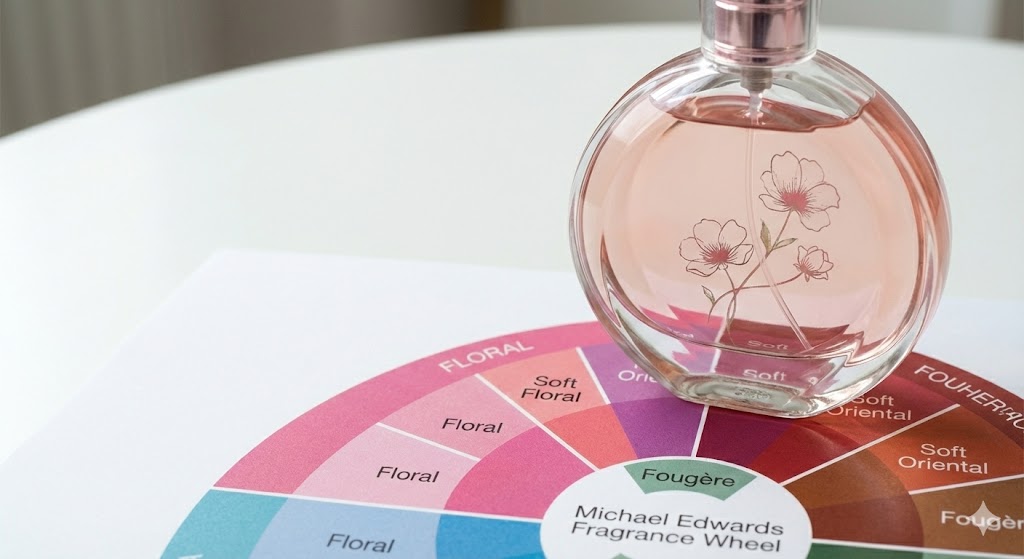
This final image shows a real-world example of a fragrance from the wheel. It features a perfume bottle with a soft pink liquid and a delicate floral design, placed next to the “Soft Floral” section of the wheel. This visualizes how a specific perfume can be categorized using the wheel.
Perfume Concentration Types: Parfum, EDP, EDT & More
Beyond scent family, the concentration of fragrance oil in a formula dramatically affects how a perfume smells, how long it lasts, and how much it costs. Higher concentration means more aromatic compounds per milliliter — richer, longer-lasting projection, and a heavier, more complex dry-down.
| Type | Oil Concentration | Longevity | Character | Best For |
|---|---|---|---|---|
| Parfum (Extrait) | 20–40% | 8–12+ hours | Richest, most complex | Evenings, special occasions |
| Eau de Parfum (EDP) | 15–20% | 4–6 hours | Strong, well-rounded | All-day wear, most occasions |
| Eau de Toilette (EDT) | 5–15% | 2–4 hours | Lighter, fresher projection | Daytime, office, warm weather |
| Eau de Cologne (EDC) | 2–4% | 1–2 hours | Light, refreshing, airy | Post-shower, summer refresh |
| Eau Fraîche | 1–3% | Under 1 hour | Very subtle, sheer | Delicate accents, body mists |
How to Choose Your Scent Type: A Practical Framework
Finding your ideal scent type doesn’t require you to know the entire history of perfumery. It starts with honest self-reflection and a systematic approach to testing. Here’s how to navigate the process without getting overwhelmed.
Step 1: Identify Your Natural Preferences
Think about smells you already love outside of perfume. Do you love the smell of fresh-cut citrus, ocean air, or rain on concrete? That points toward the fresh family. Do you love the smell of a warm bakery, vanilla, or spiced chai? Amber and gourmand families are calling your name. Love the smell of forests, old books, and cedar chests? Woody fragrances are probably your home base.
Step 2: Consider Occasion and Season
Different scent types perform differently in different environments. Fresh and citrus fragrances excel in heat and humidity — their lighter molecules project well without becoming cloying. Amber and woody fragrances come into their own in cool weather, when the warmth of the skin amplifies their richness. Florals are versatile enough for year-round wear. Aquatics belong to summer; musks and orientals belong to winter evenings.
Step 3: Test on Skin, Not Paper
Tester strips (blotters) are useful for getting a first impression of top notes, but they tell you almost nothing about how a fragrance will develop on your skin. Skin chemistry — influenced by pH, diet, hormones, and medication — transforms every fragrance differently. What smells spectacular on your friend might smell completely different on you. Always apply to skin and give it at least 20 minutes before making a decision.
Step 4: Sample Before Committing
A full bottle of even a mid-range perfume is a significant investment. Services like Scentbird, Fragrance Samples, or the decant community on fragrance forums allow you to test fragrances over multiple days before buying a full bottle. Living with a fragrance for a week gives you far more information than any store test.
Scent Layering & Pairing: Creating Your Signature
Layering fragrances — wearing two or more scents simultaneously to create something new — is one of the most creative and personal practices in fragrance culture. Done well, it can create entirely unique combinations that feel entirely your own. Done poorly, it creates a confusing olfactory mess.
Basic Layering Principles
Start with scented body products (lotion, oil, or shower gel) as a base, then apply your main fragrance on top. The scented base layer anchors the perfume and extends its longevity significantly. Choose body products with simple, complementary scents — typically plain musk, light vanilla, or unscented — to avoid competition.
Which Scent Types Layer Well Together?
Adjacent families on the fragrance wheel work best. Fresh citrus and floral notes blend seamlessly. Floral and soft amber combinations are a classic pairing. Woody notes underpin almost everything and make a tremendous layering base. Avoid pairing two heavily dominant notes from opposite ends of the wheel — fresh aquatic with smoky oriental, for instance, rarely creates something harmonious.
| Base Scent Type | Pairs Well With | Why It Works |
|---|---|---|
| Citrus / Fresh | Floral, Aromatic, Light Woody | Citrus lifts and brightens without clashing |
| Floral | Citrus, Soft Amber, Musk, Light Wood | Florals are the most versatile layering partner |
| Woody / Sandalwood | Almost everything | Warm wood anchors and extends any fragrance |
| Amber / Vanilla | Spice, Floral, Oud | Sweetness harmonizes with warm and rich materials |
| Musk | Everything — it’s a universal base | Musk adds skin-close warmth and longevity to any scent |
Skin Scents & Modern Scent Trends
Perfumery in 2025 is undergoing a quiet revolution. Several shifts are reshaping what people are looking for in fragrance, and understanding these trends helps you navigate the enormous current market.
Skin Scents
Skin scents — sometimes called “your skin but better” fragrances — are designed to smell like an idealized, slightly amplified version of your own natural scent rather than a distinct, projecting perfume. Built on clean musks, soft woods, warm skin-like molecules, and subtle florals, these are intimate fragrances that others only notice when they’re close to you. Maison Francis Kurkdjian’s Gentle Fluidity, Le Labo’s Santal 33, and various offerings from Byredo exemplify this trend.
Gender-Neutral and Unisex Fragrances
The traditional marketing divide between “masculine” and “feminine” fragrance is dissolving rapidly. Contemporary consumers increasingly prefer fragrances that express personality rather than conform to gender categories. Brands like Lush, Commodity, and D.S. & Durga now lead with completely ungendered fragrance lines.
Clean and Natural Fragrances
Growing consumer awareness of fragrance ingredients has driven significant demand for “clean” perfumes — those formulated without controversial synthetic chemicals like phthalates, parabens, and certain musks. Natural perfumery — built entirely from plant-derived essential oils, absolutes, and CO2 extracts — offers a different, more botanically authentic experience, though typically with lower longevity and projection than synthetic-forward formulas.
Oud and Niche Middle Eastern Perfumery
The influence of Middle Eastern and South Asian perfume traditions on global fragrance culture cannot be overstated. The enormous popularity of oud, frankincense, rose taif, and attar-style fragrances has brought previously niche materials into mainstream awareness, spawning entire product lines from houses like Tom Ford, Maison Margiela, and every luxury brand in between.
Seasonal Scent Guide: Which Types to Wear When
There are no hard rules in fragrance — the only rule is what makes you feel good. But certain scent types genuinely perform better in certain weather conditions, and understanding that chemistry saves you from the disappointment of your favorite heavy oriental turning cloying in August heat.
| Season | Best Scent Types | Why | Examples |
|---|---|---|---|
| Spring | Fresh Floral, Green, Light Citrus | Mirrors blooming nature; light projection matches mild temps | Marc Jacobs Daisy, Hermès Un Jardin |
| Summer | Citrus, Aquatic, Light Aromatic | Heat amplifies lighter molecules; feels clean, not overwhelming | Acqua di Gio, 4711, Davidoff Cool Water |
| Autumn | Woody, Spicy Floral, Soft Amber | Cooling temps call for warmth; richer materials project beautifully | Chanel Coco, Dior Fahrenheit |
| Winter | Amber/Oriental, Oud, Gourmand, Dense Woody | Cold air keeps heavy molecules close; layers beautifully with clothing | YSL Opium, Thierry Mugler Angel, Black Orchid |
🗝️ Key Takeaways
- The fragrance wheel organizes all scents into four core families: Floral, Fresh, Woody, and Amber — with dozens of subfamilies branching from each.
- Every perfume has three layers of notes — top, heart, and base — that unfold over time and create the full olfactory story.
- Concentration determines longevity: Parfum lasts longest; Eau Fraîche is the most ephemeral. Choose based on occasion and personal preference, not prestige.
- The best way to find your scent type is to start with environments you love (ocean, forest, bakery, garden) and work backward to the fragrance family that captures that feeling.
- Always test on skin, not paper — and wait at least 20 minutes before deciding whether you love or hate a fragrance.
- Scent layering is an art: adjacent families on the fragrance wheel blend harmoniously; opposite families create contrast that’s harder to manage.
- Modern perfumery is moving toward skin scents, gender-neutral formulas, and clean ingredients — worth exploring if traditional perfumery hasn’t resonated with you yet.
- Seasonal context matters: lighter scent types in warm weather, richer ones in cold — not as a rule, but as a practical starting point.
📝 Summary
Fragrance is one of the most intimate forms of personal expression — invisible, immediate, and powerfully connected to memory and emotion. Understanding the different types of scents transforms you from a passive consumer into someone who can navigate the enormous world of perfumery with real knowledge and confidence.
The four core fragrance families — Floral, Fresh, Woody, and Amber — provide your foundational vocabulary. Specialty categories like Gourmand, Chypre, Fougère, Aromatic, and Aquatic add nuance and depth. Concentration levels determine how a fragrance performs on skin and for how long. And emerging trends like skin scents, clean perfumery, and gender-neutral formulations are continuously expanding the possibilities.
Most importantly: fragrance is entirely personal. There is no wrong answer. The “right” scent is the one that makes you feel most like yourself — or most like who you want to be. Use this guide as your starting point, then let your nose lead the way.
FAQ
What are the main types of scents in perfumery?
The four main fragrance families are Floral, Fresh, Woody, and Amber (Oriental). Beyond these core categories, important specialty types include Gourmand, Chypre, Fougère, Aromatic, Aquatic, and Green scents. Most perfumes belong primarily to one family while blending elements from adjacent categories.
What is the difference between a top note, heart note, and base note?
Top notes are the first scents you smell — light, volatile, and lasting 15–30 minutes. Heart notes (middle notes) form the core character of the fragrance and last 2–5 hours. Base notes are the deep, rich, long-lasting foundation that anchors the fragrance and can linger for 6–12+ hours. All three work together to create the complete olfactory experience.
What’s the longest-lasting type of perfume?
Parfum (also called Extrait de Parfum) has the highest concentration of fragrance oil, typically 20–40%, making it the longest-lasting type — often 8 to 12 hours or more. Eau de Parfum (EDP) at 15–20% is a close second. The specific materials in a formula also matter enormously — heavy base notes like musks, ambers, and woods always outlast light citrus top notes regardless of concentration level.
What scent type is best for beginners?
Fresh and floral fragrances are generally recommended for beginners because they’re widely liked, versatile, and relatively easy to wear in multiple contexts. Citrus and clean aquatic fragrances are particularly forgiving and crowd-pleasing. Amber and oud-heavy orientals are better explored once you’ve developed some fragrance vocabulary and know what you’re looking for in a complex composition.
Can men wear floral fragrances and women wear woody ones?
Absolutely. Fragrance has no gender — only marketing does. Historically, floral fragrances were marketed to women and woody/aromatic ones to men, but contemporary perfumery has moved decisively toward gender-neutral territory. Many of the world’s most acclaimed niche fragrances are entirely unisex. Wear what makes you feel good, regardless of who the bottle’s advertising is aimed at.
What does “gourmand” mean in perfumery?
Gourmand fragrances are those that smell edible — like desserts, baked goods, coffee, chocolate, or caramel. The term comes from the French word for a food lover. The category was largely defined by Thierry Mugler’s Angel (1992), which introduced cotton candy and chocolate notes into fine perfumery and triggered a revolution in sweet, food-like compositions that continues to this day.
What is oud and why is it so expensive?
Oud (agarwood) is one of the rarest and most expensive fragrance materials in the world. It’s produced when the Aquilaria tree becomes infected with a specific mold and creates a dark, resinous heartwood in response. Less than 2% of wild Aquilaria trees produce oud naturally, and the extraction process is labor-intensive. The resulting material smells deeply complex — smoky, animalic, woody, and leathery all at once — making it irreplaceable in perfumery.
How do I know which scent type suits my personality?
Start by identifying environments and natural smells you already love. If you love the ocean, try aquatic and fresh fragrances. If you love the smell of warm kitchens, explore gourmand and amber scents. If you love forests and outdoor spaces, woody and green fragrances are your natural territory. There’s no personality quiz that replaces actual testing — but beginning with what you already love gives you a powerful head start.
Do different types of scents have different emotional effects?
Yes — scent is directly processed by the limbic system, the brain’s emotional and memory center, which is why fragrance has such a powerful connection to mood and memory. Research in aromatherapy and psychophysiology suggests citrus scents are energizing and mood-lifting; lavender and sandalwood are calming; rose and jasmine support feelings of romance and warmth; vetiver and patchouli are grounding. These effects are real, though their intensity varies significantly between individuals.
What’s the difference between natural and synthetic perfumes?
Natural perfumes are made exclusively from plant-derived materials — essential oils, absolutes, and CO2 extracts from flowers, woods, resins, and citrus. They tend to smell more complex, botanically authentic, and alive, but typically have less longevity and projection than synthetic formulas. Synthetic perfumes use lab-created aromatic molecules, which can replicate natural scents more consistently and affordably, and allow perfumers to create materials that don’t exist in nature. Most modern perfumes use a blend of both.