

How to Use Perfume Properly (Expert Fragrance Tips)
Using perfume properly is an art that transforms a simple beauty routine into a sophisticated ritual. While spraying fragrance might seem straightforward, expert techniques can dramatically enhance your scent’s longevity, projection, and overall impact. Whether you’re new to fragrances or looking to refine your approach, this comprehensive guide covers everything from application methods to storage solutions and stain removal.
The difference between someone who simply wears perfume and someone who truly understands fragrance often comes down to technique. Proper application ensures your scent develops beautifully throughout the day, while smart storage preserves your investment. Understanding these fundamentals elevates your fragrance experience from ordinary to exceptional.
Why Proper Perfume Use Matters
Perfume is one of the most personal and powerful accessories you can wear. Applied correctly, it becomes an invisible signature that leaves lasting impressions. Applied incorrectly, it can overwhelm, fade too quickly, or even damage your clothing.
Understanding proper perfume use maximizes your investment. Quality fragrances aren’t inexpensive, and knowing how to apply, store, and maintain them ensures you get every dollar’s worth of enjoyment. The right techniques can extend a fragrance’s presence from a fleeting moment to an all-day experience.
Beyond personal benefit, proper perfume etiquette shows respect for those around you. Fragrance should be discovered, not announced. Mastering application techniques ensures you smell wonderful without overwhelming colleagues, friends, or fellow commuters.
How to Apply Perfume
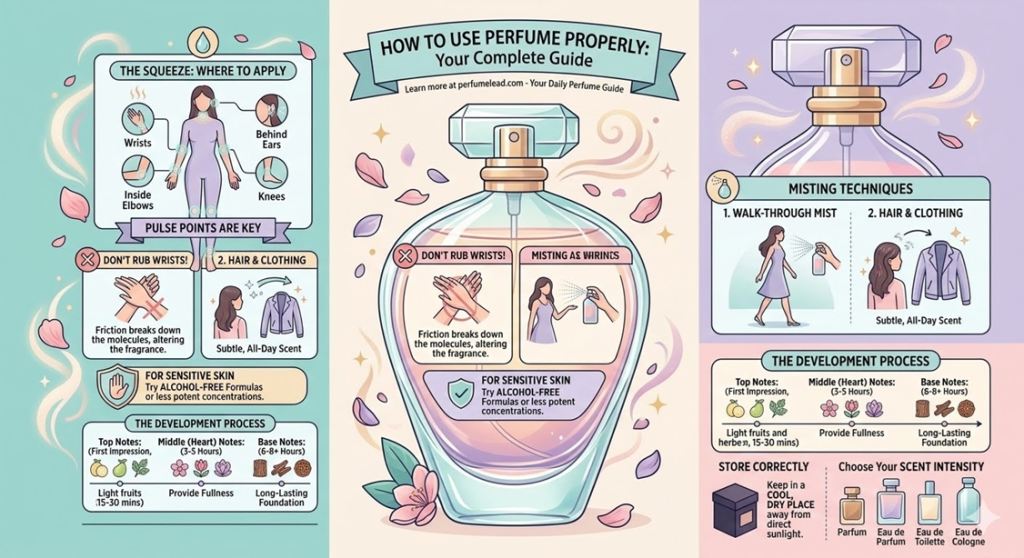
Proper application starts with understanding pulse points—areas where blood vessels sit closest to the skin’s surface, generating warmth that helps diffuse fragrance. These natural diffusers maximize your scent’s projection and longevity.
Key Pulse Points for Application:
- Wrists: The classic application spot, easily accessible and naturally warm. Apply here for immediate scent presence.
- Neck and Throat: Creates an alluring aura that rises with body heat. Perfect for fragrances you want others to notice.
- Behind the Ears: Intimate and subtle, ideal for close encounters and personal moments.
- Inner Elbows: Often overlooked but highly effective, especially in cooler weather when arms are covered.
- Behind the Knees: Fragrance rises naturally from this area, making it perfect for dresses and shorts.
- Chest: Provides a warm foundation that projects subtly through clothing.
Proper Application Technique:
Hold the bottle 5-7 inches from your skin and spray directly onto pulse points. This distance ensures even distribution without over-concentrating in one area. Avoid the common mistake of spraying into the air and walking through it—this wastes product and provides minimal lasting scent.
The Golden Rule: Don’t Rub. After applying to wrists, resist the urge to rub them together. This friction breaks down fragrance molecules, altering the scent and reducing longevity. Instead, let the perfume dry naturally on your skin.
Preparation is Key: Apply perfume to clean, moisturized skin. Fragrance lasts significantly longer on hydrated skin, as dry skin absorbs and evaporates scent quickly. Use unscented lotion or body oil before application to create a base that locks in fragrance.
Master the art of perfume application with our detailed guide.
How to Make Perfume Last Longer
Maximizing fragrance longevity involves strategic preparation, application, and maintenance. These expert techniques ensure your scent remains present from morning until night.
1. The Vaseline Trick: Apply a thin layer of petroleum jelly to pulse points before spraying perfume. This creates an occlusive barrier that locks fragrance to your skin, significantly extending wear time.
2. Layer Your Fragrance: Use matching shower gel, body lotion, and perfume from the same line. This creates multiple layers of scent that reinforce each other, providing a foundation that lasts far longer than perfume alone.
3. Spray on Clothing: Natural fabrics like cotton, wool, and linen hold fragrance exceptionally well. A light spritz on clothing (avoiding delicate fabrics like silk) provides lasting scent that survives even when skin fragrance fades.
4. Target Oily Areas: Fragrance clings better to slightly oily skin. The top of your ears, behind your ears, and chest tend to be oilier than other areas, making them excellent application spots for extended wear.
5. Hair Application: Hair holds fragrance beautifully, but direct spraying can dry out strands. Instead, spray your hairbrush and run it through your hair, or use dedicated hair fragrance products designed for this purpose.
6. Choose the Right Concentration: Eau de Parfum formulations last 6-10 hours compared to Eau de Toilette’s 3-5 hours. For all-day wear, invest in higher concentrations that provide lasting presence.
7. Reapply Strategically: Carry a travel atomizer for touch-ups. Reapply to pulse points when you notice fading, typically every 4-6 hours for EDT and 6-8 hours for EDP.
8. Climate Considerations: Hot, humid weather causes faster evaporation. In summer, apply lighter scents more frequently or choose fragrances with heavier base notes that withstand heat better.
Discover more expert tips for extending your fragrance’s lifespan.
How to Store Perfumes
Proper storage preserves fragrance quality and extends shelf life. Perfume is surprisingly delicate, vulnerable to environmental factors that can degrade its molecular structure and alter its scent.
The Three Enemies of Perfume:
1. Light: UV rays break down fragrance molecules, causing deterioration and discoloration. Always store perfume away from direct sunlight. Keep bottles in original boxes or dark drawers. Clear bottles are particularly vulnerable—extra care is essential.
2. Heat: High temperatures accelerate chemical reactions that alter fragrance composition. Avoid storing perfume near windows, radiators, or heating vents. Ideal storage temperature is 60-70°F (15-21°C).
3. Humidity: Moisture introduces unwanted chemical reactions and can affect packaging. Never store perfume in bathrooms, despite convenience. The humidity from showers creates a damaging environment.
Best Storage Practices:
- Store bottles upright to prevent leakage and air exposure
- Keep caps tightly sealed when not in use
- Use original packaging for maximum protection
- Avoid temperature fluctuations (don’t store in cars)
- Keep away from air conditioning vents that cause temperature swings
Shelf Life Expectations: Most perfumes maintain optimal quality for 3-5 years when properly stored. Citrus-heavy fragrances deteriorate fastest due to volatile top notes. Orientals and woods last longest thanks to stable base notes. If you notice significant color changes or scent alterations, it’s time to replace the bottle.
Travel Storage: When traveling, protect perfume from extreme temperatures in cars and airplanes. Use small decants rather than exposing full bottles to temperature fluctuations. Never leave perfume in checked luggage where cargo hold temperatures can damage the fragrance.
How to Remove Perfume Stains
While applying perfume to clothing extends fragrance life, it can occasionally cause stains—particularly on delicate fabrics or with darker-colored fragrances. Knowing how to remove these stains protects your wardrobe investment.
Immediate Action for Fresh Stains:
Act quickly when you notice a perfume stain. Blot (don’t rub) with a clean, damp cloth to lift as much fragrance as possible. For fresh stains on white or colorfast fabrics, cold water often removes the mark completely.
Method 1: Vinegar Solution
Mix equal parts white vinegar and water. Dampen a clean cloth with this solution and gently dab the stain. For stubborn marks, soak the fabric in the vinegar solution for 15-30 minutes before laundering. Vinegar breaks down fragrance oils without damaging most fabrics.
Method 2: Dish Soap Treatment
Apply a small amount of mild liquid dish soap directly to the stained area. Let it sit for 5-10 minutes, then gently work the soap into the fabric with your fingers. Rinse thoroughly with cool water before washing normally.
Method 3: Enzyme Detergent Soak
For set-in stains, soak the fabric in warm water mixed with enzyme-based laundry detergent for 30 minutes. Enzymes break down organic compounds in fragrance oils. After soaking, launder as usual.
Method 4: Baking Soda Paste
Create a paste using baking soda and water. Apply to the stain and let dry completely. The baking soda absorbs oils and lifts the stain. Brush off residue and launder normally.
Prevention Tips:
- Allow perfume to dry completely before dressing
- Spray from proper distance (5-7 inches) to prevent concentrated spots
- Test fragrances on hidden fabric areas before full application
- Avoid spraying directly on silk, satin, or delicate fabrics
- Use the “mist and walk through” technique for even distribution
Important: Always check the stain has been completely removed before putting items in the dryer. Heat sets stains permanently, making them impossible to remove later.
Get detailed instructions for removing perfume stains from all fabric types.
Common Perfume Mistakes to Avoid
Even experienced fragrance enthusiasts make mistakes. Avoid these common pitfalls to maximize your perfume experience.
Mistake 1: Rubbing Wrists Together
This breaks down fragrance molecules and alters the scent profile. Let perfume dry naturally.
Mistake 2: Over-Application
More isn’t better. Start with 2-3 sprays and add more if needed. Overwhelming others with scent is worse than smelling too subtle.
Mistake 3: Storing in Bathrooms
Humidity and temperature fluctuations destroy fragrance quality. Find a cool, dry closet or drawer instead.
Mistake 4: Testing Too Many at Once
Olfactory fatigue sets in after 3-4 fragrances. Take breaks, smell coffee beans between tests, and limit testing sessions.
Mistake 5: Buying Without Skin Testing
Paper strips only show top notes. Always test on skin and wait several hours to experience the full fragrance evolution.
Mistake 6: Ignoring Seasonality
Heavy orientals overwhelm in summer; light citruses disappear in winter. Match fragrance weight to season for optimal performance.
Mistake 7: Shaking the Bottle
This introduces air and can alter the fragrance composition. Handle bottles gently and store upright.
Mistake 8: Spraying Directly on Jewelry
Fragrance oils can tarnish metals and damage gemstones. Apply perfume before putting on jewelry.
Frequently Asked Questions
How many sprays of perfume should I use?
For Eau de Parfum, 2-4 sprays are typically sufficient. For Eau de Toilette, 3-5 sprays may be needed. Start conservatively—you can always add more, but removing excess is impossible. Consider your environment: use less in close quarters, more for outdoor events.
Can I mix different perfumes?
Layering fragrances is an advanced technique that can create unique scents, but it requires knowledge of how notes interact. Start by layering fragrances from the same family or line. Avoid mixing more than two scents, and test combinations on skin before wearing them out.
Why can’t I smell my perfume after a few hours?
Olfactory fatigue causes you to become “nose blind” to scents you wear regularly. Others can still smell your fragrance even when you can’t. If longevity is truly poor, try moisturizing before application, switching to EDP concentration, or spraying on clothing.
Is it okay to spray perfume on clothes?
Yes, and it often extends fragrance life. However, test on hidden areas first as some fragrances can stain. Avoid delicate fabrics like silk and satin. Natural fibers (cotton, wool, linen) hold scent best without damage risk.
How do I know if my perfume has gone bad?
Signs of degradation include significant color changes (especially darkening), sour or “off” smells, weakened projection, and separation of ingredients. Properly stored perfume lasts 3-5 years, though citrus fragrances deteriorate faster than orientals.
Should I wear different perfumes for different seasons?
While not mandatory, seasonal fragrance selection enhances the wearing experience. Light, fresh scents work best in spring and summer; warm, rich fragrances excel in fall and winter. Some versatile scents work year-round, but building a seasonal wardrobe provides optimal options.
Master the Art of Fragrance
Using perfume properly transforms a simple beauty routine into an elevated self-care ritual. By mastering application techniques, maximizing longevity, storing correctly, and knowing how to handle stains, you ensure your fragrance investment provides maximum enjoyment.
Remember that fragrance is deeply personal. While these guidelines provide a strong foundation, don’t be afraid to experiment and find what works best for your unique skin chemistry, lifestyle, and preferences. The best perfume advice is to wear what makes you feel confident and authentic.
Continue exploring our detailed guides to deepen your fragrance knowledge and perfect your perfume routine.
Ready to become a fragrance expert? Explore our in-depth guides on how to apply perfume, making perfume last longer, and removing perfume stains for comprehensive fragrance mastery!


